
Onslow County Criminal Court Records
A criminal court record is the case-level file kept by the Clerk of Superior Court after charges are filed and court action begins. In Onslow County, that file can include the charging instrument, docket entries, bond or first appearance data, arraignment status, motions, pleas, hearing settings, verdicts, dismissals, judgments, sentencing orders, probation conditions, costs, restitution, and notices of appeal. It is a court file, not a sheriff booking log.
North Carolina's trial courts are split between Superior Court and District Court. In Onslow County, Superior Court handles felony criminal matters, major trials, and appeals from District Court. District Court handles misdemeanors, infractions, traffic offenses, initial appearances, bond-related steps, and many high-volume criminal settings. Magistrates are important at the front end because they may handle initial appearances, warrants, and bond determinations, but the criminal court record continues through the clerk's case file.
For the arrest-to-charge pathway itself, including charge status and how charges may be amended or dismissed, use the Onslow County arrest records and court charges page. The full criminal court case file and outcome remain the focus here.
Search Onslow County Criminal Cases
Most public criminal case lookup starts with the North Carolina eCourts Portal. Smart Search can locate case information, while Search Hearings can locate court dates by case number, party name, business name, attorney name, attorney bar number, judicial officer, or courtroom. The Portal may also support payments for eligible criminal and infraction costs, fees, restitution, criminal attorney fees, probation fees, and parole fees.
- Open the eCourts Portal and begin with Smart Search for the criminal case record.
- Use the case number if known, or search by defendant name when the number is missing.
- Confirm that the county is Onslow and check whether the matter is in Superior Court or District Court.
- Review docket entries for charges, hearings, pleas, motions, disposition, judgment, sentence, and financial obligations.
- Use the Clerk of Superior Court for public terminals, paper files, certified copies, or older records that are not clear online.
Public self-service terminals in clerk offices can search criminal case information by defendant name, case number, and victim or witness name. That terminal route is important when online results are incomplete or when a case is public but not easy to retrieve remotely. The Onslow County Clerk of Superior Court is the local custodian for state criminal court files.
Onslow County Criminal Case Flow
Criminal court records should be read in sequence. A case may begin with charges and bond, move through an arraignment or first settings, continue through pretrial motions, and end with a plea, trial, dismissal, or other disposition. Felony cases may begin in District Court for first appearance or probable-cause steps, then move to Superior Court after indictment or information. Misdemeanors often remain in District Court unless appealed.
Case flow: Charges Filed › Arraignment › Pretrial and Motions › Plea or Trial › Disposition › Sentencing
| Stage | What the Criminal Court Record May Show |
|---|---|
| Charges filed | Offense, statute, charge level, warrant or charging document, bond, and first court setting. |
| Arraignment | Formal charge status, counsel status, plea posture, and future settings. |
| Pretrial and motions | Continuances, discovery-related events, suppression motions, bond motions, and orders. |
| Plea or trial | Guilty plea, not guilty plea, verdict, dismissed charge, amended charge, or negotiated resolution. |
| Disposition | The outcome for each charge, including guilty, not guilty, dismissed, or other final action. |
| Sentencing | Judgment, probation, jail or prison sentence, fines, court costs, restitution, and conditions. |
What Onslow Criminal Records Show
Onslow County criminal court records combine docket data with court-file content. A public result may show the case number, court division, defendant, charges, hearing dates, attorney fields, judicial officer, docket entries, disposition, sentencing, financial obligations, and restrictions. Some data is visible online, some is available at public terminals, and some requires the paper file or clerk copies.
| Field | What It Shows |
|---|---|
| Case number | The main identifier used for Portal searches, terminal searches, and clerk requests. |
| Court division | Superior Court for felonies and higher trial matters, or District Court for many misdemeanors and infractions. |
| Defendant | The person charged in the criminal case, with party details subject to redaction rules. |
| Charges | The alleged offenses, statutory references, charge status, and possible amendments or dismissals. |
| Attorney fields | Defense counsel, prosecutor-related entries, attorney name, or bar number where indexed. |
| Docket entries | Filings, motions, continuances, warrants, bond events, pleas, orders, judgments, and notices. |
| Disposition | The outcome for each charge, not just the case as a whole. |
| Sentence | Probation, confinement, suspended sentence, costs, fines, restitution, or related conditions. |
Onslow County Prosecutor Role
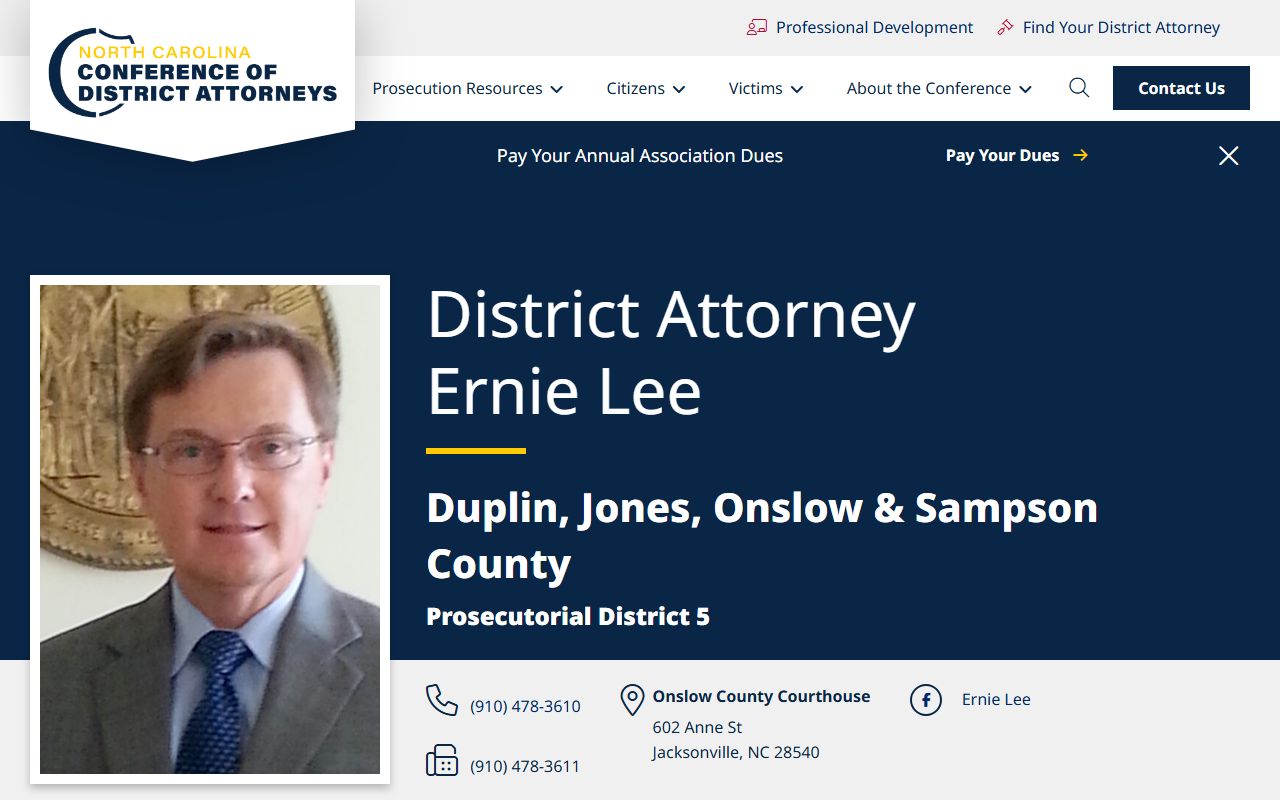
Onslow County is in Prosecutorial District 5 with Duplin, Jones, and Sampson counties. The District Attorney is the office that prosecutes state criminal charges after law enforcement files charges, indictments are returned, or cases are otherwise assigned for prosecution. Official sources list District Attorney Ernie Lee at the Onslow County Courthouse, 602 Anne Street, Jacksonville, NC 28540, with phone 910-478-3610.
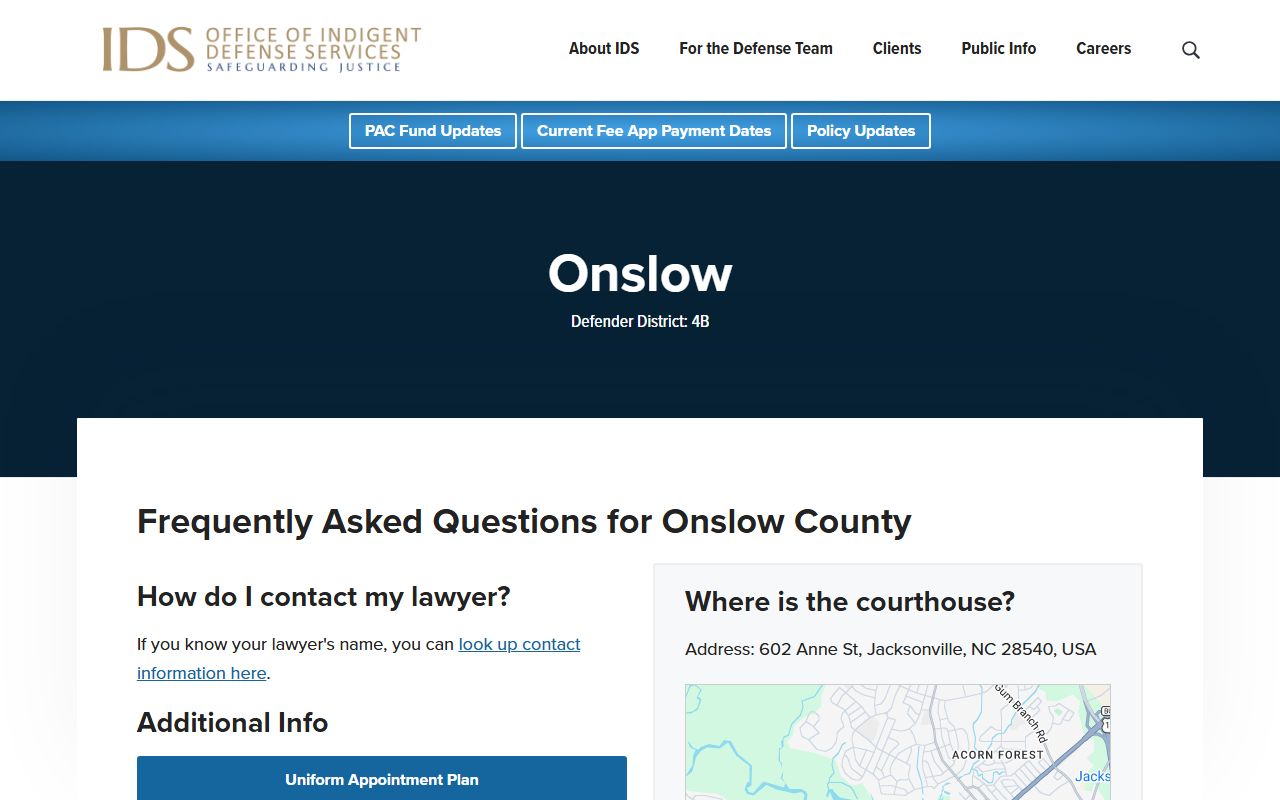
The prosecutor role affects the criminal court record because charges may be prosecuted, reduced, dismissed, superseded by indictment, resolved by plea, or tried. A docket entry can show the court result, but it does not always explain the negotiation or legal reason behind a change. Defendants who cannot afford counsel use the court process and North Carolina Indigent Defense Services routing for appointed counsel.
The Prosecutorial District 5 page identifies the District Attorney office tied to Onslow County criminal court records.
The Indigent Defense Services Onslow County page is the official starting point for appointed-counsel routing.
Onslow Charges vs Convictions
A criminal court record can show both accusations and outcomes. Being charged does not mean a person was convicted. A single case may include several charges with different outcomes, such as one dismissed charge, one reduced charge, and one guilty plea. When reading Onslow County criminal court records, the disposition line for each charge matters more than the fact that the charge once appeared.
| Comparison Point | Charge | Conviction |
|---|---|---|
| Meaning | An accusation filed through law enforcement, magistrate, prosecutor, indictment, or information. | A final guilty finding or accepted guilty plea entered by the court. |
| Record role | May appear early and later be amended, reduced, dismissed, or superseded. | Appears as an outcome and may connect to sentence, costs, probation, or appeal rights. |
| Proof level | Based on probable cause or charging standards. | Requires proof beyond a reasonable doubt or a valid guilty plea. |
| Expunction relevance | Dismissed charges or not guilty findings may have different expunction paths. | Convictions have stricter eligibility rules and waiting periods. |
Reading Dispositions and Sentences
The disposition is the outcome of a charge or case. Common outcomes include guilty, not guilty, dismissed, judgment entered, or another final action shown by the court. Sentencing entries may include active confinement, suspended sentence, probation, fines, costs, restitution, criminal attorney fees, compliance requirements, and appeal-related entries. Portal payment features may show eligible financial obligations, but payment access is not the same as a full sentencing document.
Onslow County criminal court records can also include bond information, first appearance data, and later compliance events. The Onslow payment page notes that Criminal District Court handles traffic tickets and most misdemeanor cases, and the cashier for Criminal District Court is located between courtrooms 1 and 2 on the second floor of the Summersill Building. That practical point may matter after a disposition when a person needs to resolve court costs in person.
Note: A criminal docket should be read charge by charge because each charge can have a different disposition or sentence.
Public Access to Onslow Criminal Records
Public access to Onslow County criminal court records is shaped by North Carolina record laws and court rules. N.C.G.S. 132-1 defines public records broadly. N.C.G.S. 7A-109 addresses court record keeping and electronic records, including judgment indexing and remote access authority. In practice, criminal court records may be searched through Portal, public terminals, and clerk paper files unless a restriction applies.
Law enforcement investigative records are a different category. N.C.G.S. 132-1.4 limits criminal investigation and intelligence records, so an arrest report, open investigation file, search warrant affidavit, or body-camera item may not be available just because the court case itself is public. County government NextRequest is not the correct path for court-related records, background checks, marriage, divorce, or property records.
Sealed vs Expunged Records
Sealing and expunction are not the same. A sealed criminal court record is hidden from public inspection by statute or court order, but limited court or agency access may still exist. An expunction is a court process that clears eligible public entries as directed by the order. Juvenile court records, abuse or neglect files, adoption records, sealed matters, and expunged entries should not be expected to appear in normal Onslow County criminal court record searches.
| Comparison Point | Sealed | Expunged |
|---|---|---|
| Public visibility | Hidden from ordinary public inspection. | Cleared from public records as directed by the expunction order. |
| Source | Statute or court order. | Petition and order under an eligible expunction statute. |
| Common examples | Juvenile, adoption, protected victim, or court-sealed materials. | Dismissed charges, not guilty findings, or certain eligible nonviolent convictions. |
| Public search effect | May show no public document or no public case detail. | Public background checks should not disclose expunged entries, subject to legal exceptions. |
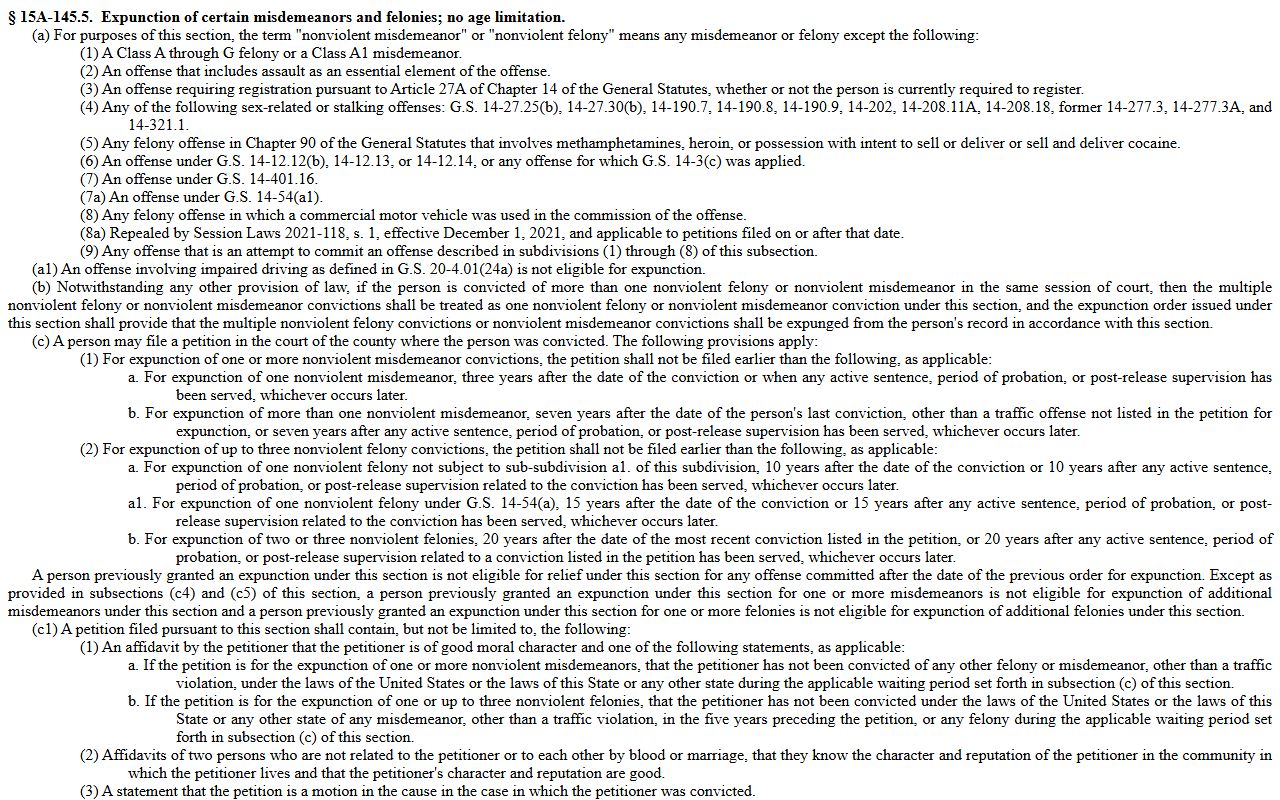
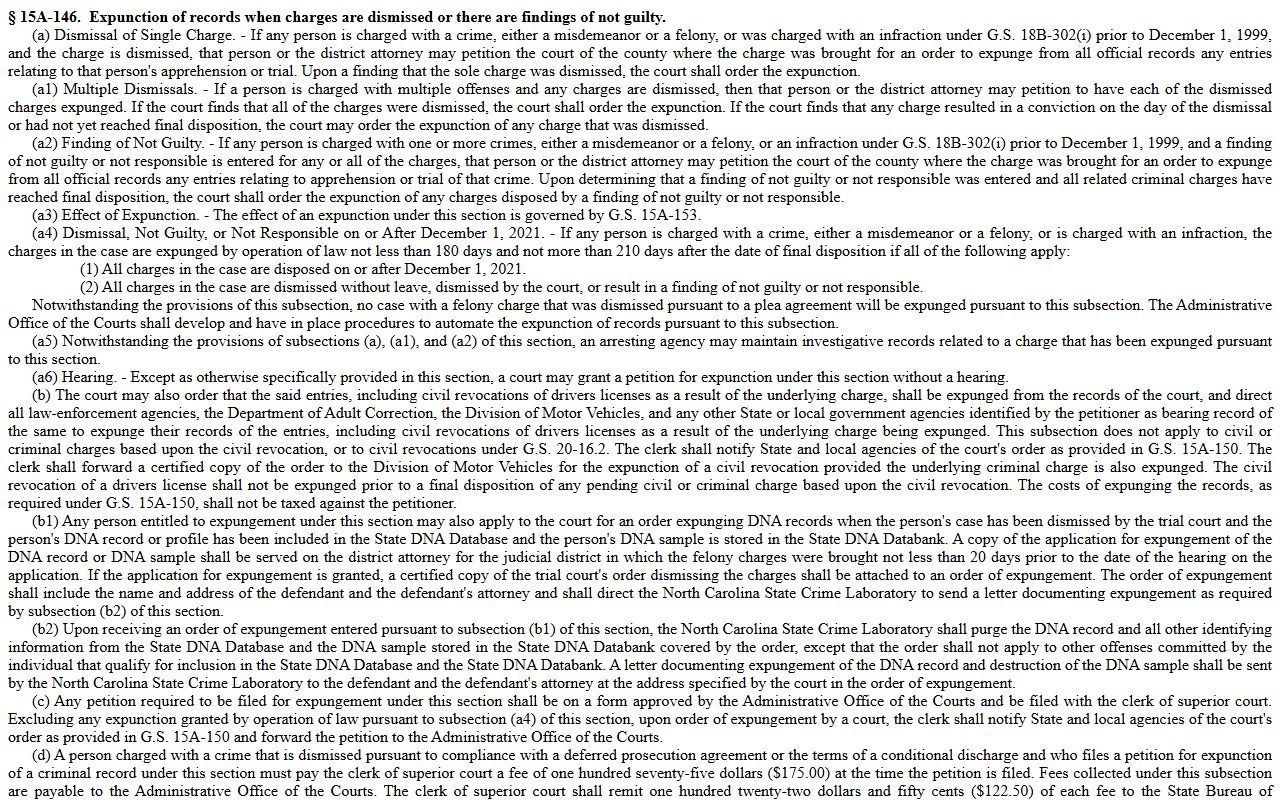
N.C.G.S. 15A-145.5 provides expunction paths for certain nonviolent misdemeanor and felony convictions after statutory waiting periods and conditions. N.C.G.S. 15A-146 provides paths when charges are dismissed or result in not guilty findings.
The nonviolent conviction expunction statute explains one major path for clearing eligible Onslow County criminal court records.
The dismissal and not guilty expunction statute applies to a different class of criminal court records.
Restricted Onslow Criminal Records
Restricted criminal records include juvenile delinquency and undisciplined matters, abuse or neglect records, sealed cases, expunged records, protected victim information, certain personal identifiers, and law enforcement investigation files. Public Portal searches, clerk terminals, and ordinary records requests do not override those limits. If a record is sealed or expunged, the public result may be absent or incomplete even when the person knows the case once existed.
For background checks, a court case lookup is not the same as an FCRA-compliant consumer report. Court records can help verify case status, but employment, tenant, credit, insurance, and other regulated screening uses require the proper legal process and current, verified records from the official custodian or an authorized screening provider.